


Introduction
One of the new markup elements introduced in HTML5 is the summary markup element.
As the name suggests, the summary markup element is an interactive markup element used to represent summary context of your web page.
The HTML5 specification says…
The HTML5 specification for summary markup element http://www.w3.org/TR/html-markup/summary.html specifies that the element can be used to represent a summary, caption or legend.
It also mandates that the summary markup element must have both a starting and an ending tag.
The summary markup element can also be inside a details markup element. When inside a details markup element, the summary element is visible irrespective of whether the open attribute of the details markup element is specified or not.
Hands-On
Let us write a simple HTML5 web page that uses a summary markup element.
<!DOCTYPE html>
<html>
<meta charset=”utf-8″>
<title>Summary sample</title>
<body>
<header>
<h1>Summary markup element sample</h1>
<p>Demo showing summary markup element</p>
</header>
<summary>Summary element outside details markup element.</summary>
<details open>
<summary>Another Summary markup element inside details markup element</summary>
</details>
<footer>
<p>HTML Goodies</p>
</footer>
</body>
</html>
The web page is rendered in Google Chrome as under.
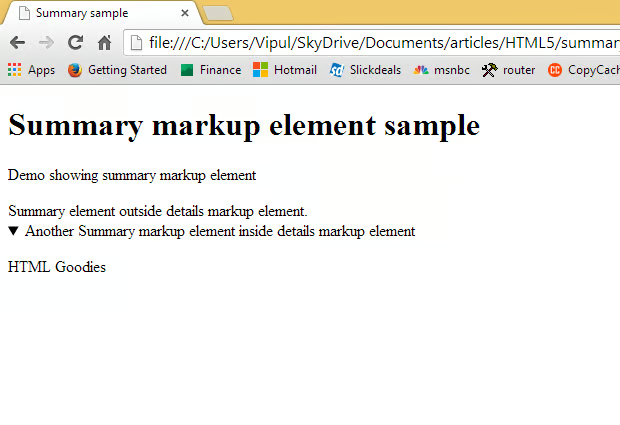
Summary
In this article, we saw how simple it was to use the summary markup element in a HTML5 web page. You can download the sample code from <download link>.
References
http://www.w3.org/TR/html-markup/summary.html
About the author
Vipul Patel is a Program Manager currently working at Amazon Corporation. He has formerly worked at Microsoft in the Lync team and in the .NET team (in the Base Class libraries and the Debugging and Profiling team). He can be reached at vipul.patel@hotmail.com
